
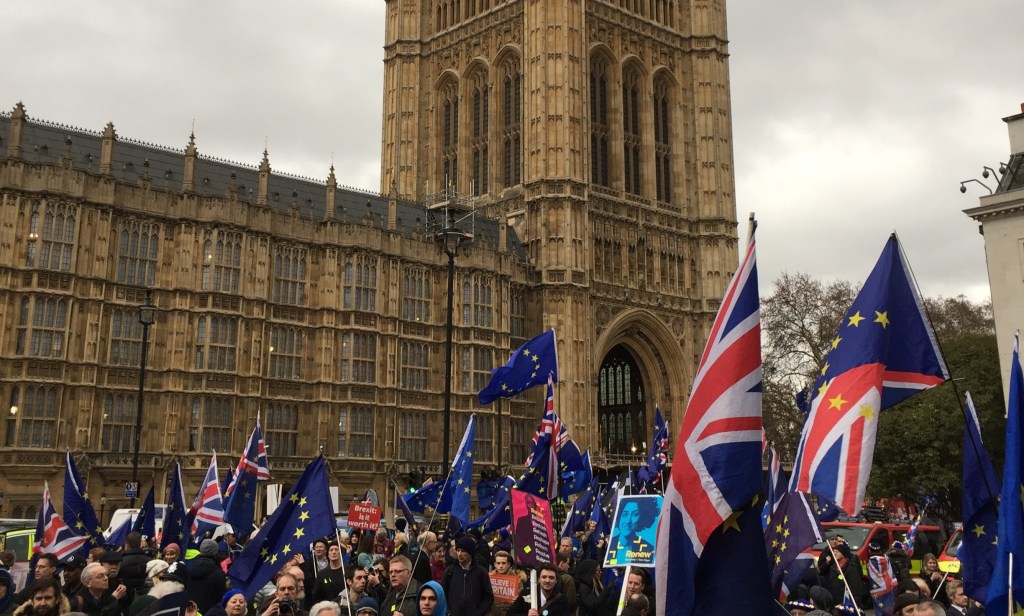
I had just finished high school a couple of months earlier, and my parents had decided this was the year they were going to take me and my sister somewhere we’d never been before- Europe. While my parents and sister were excited for the landmarks, the food, and the several billion churches we saw over those 28 days, the highlight of my trip had occurred a day earlier, when we visited the UK Parliament, and unexpectedly had run into an anti-Brexit protest. Despite all the landmarks of the past that I’d seen on the trip, they couldn’t compare to how I felt then- like I got to witness a part of history.
My university journey really began 2 nights after this: still in London, at approximately midnight. I received an email containing the news of whether I had been accepted into my preferred university and course.
Somewhat unexpectedly, I had.
I had applied to Law/International Studies at Deakin as my top preference, but my ATAR was just shy of the score I needed to be admitted, and, I had more or less accepted that I wouldn’t get in. Now I needed to process the fact that I’d actually be a law student.
I had always known I was going to study politics in some form, simply because I had always found politics fascinating- however, it wasn’t always so obvious that I would go on to study law. As such, at the beginning of my degree, very much enjoying the freedom and passion that came with International Studies, I felt the urge to dismiss law in my mind- as a degree that I would complete, but not necessarily value in the same way. However, I would come to see both degrees as equally valuable.
International Studies was where I thrived: due to my passion for the subject, the minimal direction and freedom worked incredibly well for me, as I felt free to research and write about whatever topics fascinated me at that time.
However, Law pushed me out of my comfort zone, and has enhanced my writing simply by exposing me to a different writing style- informative, analytical and specific.
“The Convention is not intended to be a ‘human rights convention’,[1] and therefore, instead of putting human rights obligations on this Convention, other UN treaties should be further developed, particularly regarding the right to privacy. In a 2017 conference submission, Eliza Watt proposes updating General Comment 16 to “affirm that Article 17 applies to informational privacy, which is understood as the individual’s right to access and control personal data”.[2]“
[1] Tatiana Tropina, ‘‘This is not a human rights convention!’: the perils of overlooking human rights in the UN cybercrime treaty’ (2024) 9(2) Journal of Cyber Policy 200 p 212.
[2] Eliza Watt, ‘The role of international human rights law in the protection of online privacy in the age of surveillance’, (2017) 9th International Conference on Cyber Conflict (CyCon) p 5.
-Human Rights Law 2025, Evaluation of UN Convention Against Cybercrime
“While international bodies insofar have been successful in promoting dialogue between states, such as in the UN Framework Convention on Climate Change, the lack of a binding authority to enforce state emissions reduction targets ultimately limits any action that can be taken. Furthermore, any international agreement on climate change will be subject to debate regarding the equal participation of states in this global governance, as not all states have contributed to carbon emissions equally, nor has the capacity to reduce these equally.”
– Activists Beyond Borders 2023, How does transnational activism shape global governance and policy-making?
The combination of these two degrees has given me another useful skill: perspective, and the ability to change perspectives, even in relation to the same topic. Law has pushed me to develop detail-oriented skills, looking at information through a microscope- looking at one specific law, in one specific country, in one specific time. International Studies has allowed me to look at these exact same circumstances, but to instead see the broader picture- to see how the international environment shaped these circumstances, and how it may progress in future.
 The Wonderful World of International Relations - A Portfolio & Archive
Leave a comment